
Coffee has come a long way from its humble origins as a wild plant in East Africa. What started as a local custom has become a global cultural phenomenon, shaping social rituals, economies, and even revolutions. Today, coffee isn’t just a drink — it’s a lifestyle.
In this article, we explore the fascinating journey of coffee through history, how it evolved into modern coffee culture, and what it says about the world we live in.
Origins: Coffee’s Mysterious Beginnings
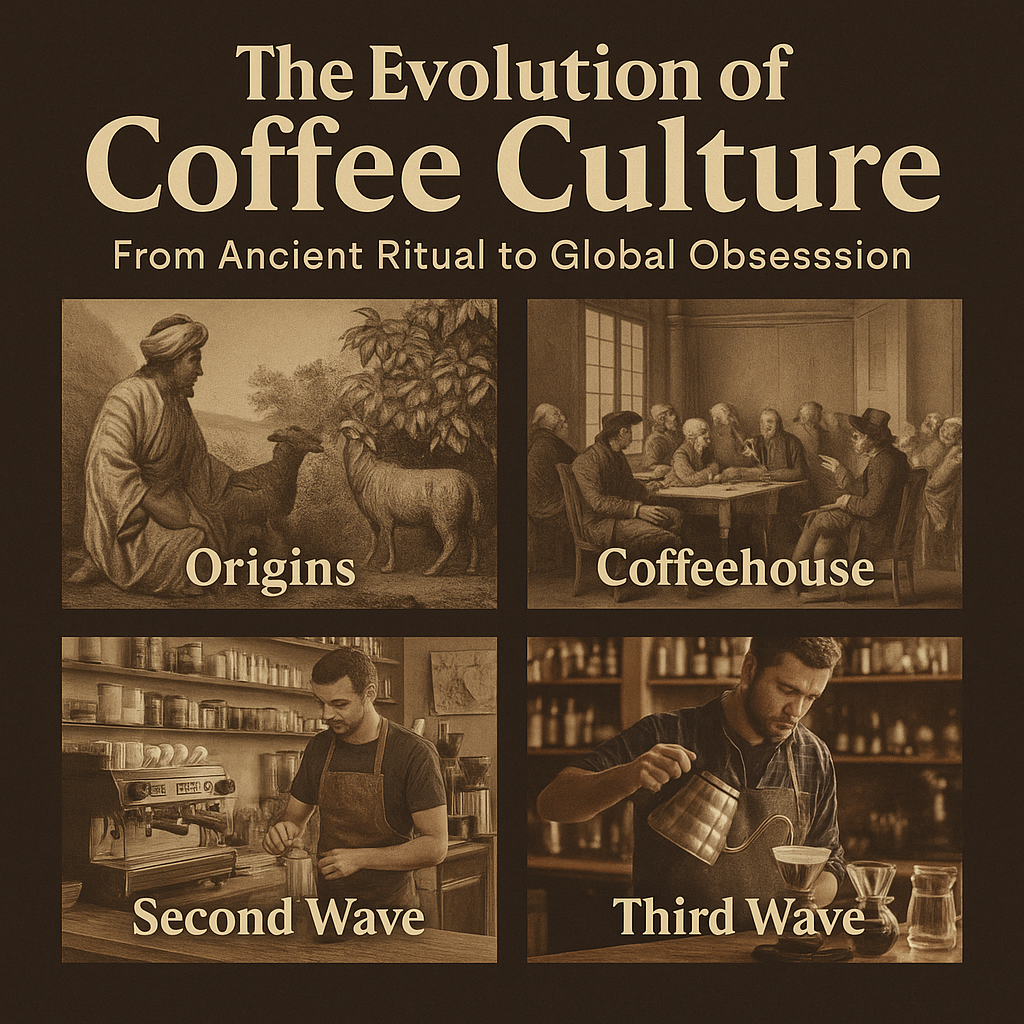
Legend has it that coffee was discovered in Ethiopia by a goat herder named Kaldi, who noticed his goats becoming unusually energetic after eating berries from a certain plant. Monks then brewed the berries into a drink to stay awake during prayers.
The first known use of coffee as a beverage dates back to the 15th century, in Sufi monasteries in Yemen, where it became part of religious rituals.
By the 16th century, coffee had spread to:
- Mecca and Cairo, where it was popular in Islamic schools
- Constantinople (Istanbul), where the first coffee houses emerged
- Europe, through Venetian trade
The Rise of the Coffeehouse
In the 17th and 18th centuries, coffeehouses became hubs for intellectuals, artists, and revolutionaries.
- In England, they were called “penny universities” — a place to buy coffee for a penny and engage in conversation.
- In France, cafés were centers of Enlightenment thought.
- In the Middle East, coffeehouses became vital social institutions where people gathered to debate, play games, and share news.
Coffee played a role in social movements, revolutions, and the rise of modern public discourse.
Industrialization and Global Coffee Trade
As demand grew, coffee cultivation expanded to colonies with ideal climates:
- Brazil
- Colombia
- Indonesia
- Vietnam
- Central America
Unfortunately, this expansion was often linked to colonial exploitation and forced labor.
By the late 1800s and early 1900s, coffee became a global commodity, with mass production and packaging making it widely accessible — but at the cost of quality.
The First Coffee Wave: Convenience Over Quality
The first wave of coffee culture (early 20th century) focused on mass production:
- Instant coffee
- Canned ground coffee
- Major brands like Folgers and Maxwell House
Coffee became a household staple, but flavor and sourcing took a backseat to convenience.
The Second Wave: Specialty Coffee and Coffee Shops
The second wave began in the 1970s–1990s, with the rise of:
- Starbucks
- Peet’s Coffee
- Lavazza and Illy in Europe
This era introduced:
- Espresso drinks (lattes, cappuccinos)
- The idea of the coffee shop as a “third place” (home, work, café)
- Greater awareness of origin, roast levels, and flavor
Coffee became personal and customizable — no longer just a morning chore.
The Third Wave: Coffee as an Artisan Craft
Starting in the early 2000s, the third wave movement treated coffee like wine or craft beer — emphasizing:
- Single-origin beans
- Direct trade and ethical sourcing
- Precision brewing methods (pour-over, AeroPress, siphon)
- Light roasts to highlight origin flavor
Baristas became skilled professionals, and cafés began using coffee to tell stories about farms, farmers, and sustainability.
Coffee Today: A Global Language
Modern coffee culture is a blend of:
- Artisan traditions from third-wave cafés
- Global chains with familiar comfort
- Local customs, like Turkish coffee, Italian espresso, or Japanese iced brews
- Digital trends, such as coffee influencers, brew guides, and TikTok recipes
Coffee brings together people from all walks of life, across cultures, religions, and time zones.
How Technology Has Shaped Coffee Culture
- Espresso machines and grinders now reach pro-level quality at home
- Smart brewers can be controlled by phone
- Social media influences trends like whipped Dalgona coffee or oat milk lattes
- E-commerce allows direct access to roasters and farms around the world
Even in virtual meetings, “Let’s grab coffee” remains a universal invitation.
The Future of Coffee Culture
The next wave of coffee may focus on:
- Sustainability and climate adaptation
- Transparent supply chains
- Zero-waste cafés
- Lab-grown or synthetic coffee alternatives
- Inclusivity and accessibility in café spaces
At its core, coffee will always be about connection — to the bean, the people who grow it, and the moments we share around it.
Final Sip: A Drink That Changed the World
Coffee has shaped economies, cultures, art, and activism. It’s been a symbol of rebellion, community, innovation, and comfort. From ancient rituals to modern espresso bars, coffee tells the story of human history — one cup at a time.
As you enjoy your next brew, think about the centuries of culture and craft behind it. You’re not just drinking coffee — you’re taking part in a global tradition.