
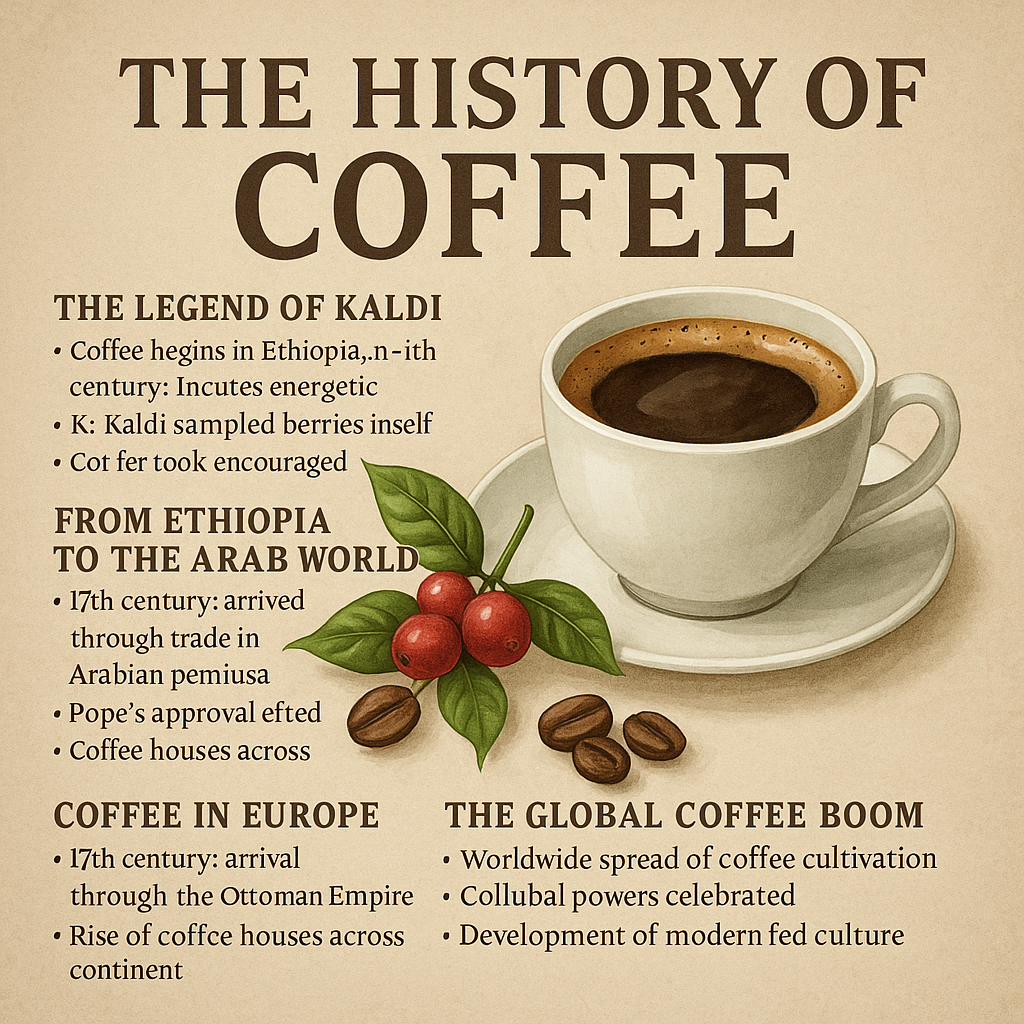
That comforting cup of coffee in your hands carries centuries of stories, trade, culture, and evolution. But where did it all begin? And how did coffee go from wild African forests to the global phenomenon it is today?
In this article, we’ll explore the fascinating journey of coffee through time — from ancient legends to modern cafés.
The Legend of Kaldi: Coffee’s Mythical Origin
The story of coffee begins in Ethiopia, around the 9th century.
According to legend:
- A young goat herder named Kaldi noticed his goats became hyperactive after eating red berries from a certain tree.
- Curious, he tried the berries himself and felt energized.
- Monks at a nearby monastery used the berries to stay awake during long prayers.
- Word of this “miracle” fruit spread — and the rest is history.
While we can’t confirm the Kaldi tale, Ethiopia is widely accepted as the birthplace of coffee.
From Ethiopia to the Arab World
By the 15th century, coffee cultivation and consumption had spread to the Arabian Peninsula.
Key historical points:
- Coffee was first cultivated in Yemen, especially in the port city of Mocha (yes, that’s where the name comes from).
- Sufi monks used coffee to stay awake during spiritual rituals.
- Coffee houses, called qahveh khaneh, emerged in cities like Mecca and Cairo — places of social, intellectual, and political exchange.
- Coffee faced religious opposition at times, but it continued to gain popularity.
The Arab world roasted, brewed, and traded coffee long before it reached Europe.
Coffee in Europe: From Curiosity to Craze
Coffee arrived in Europe in the 17th century, first through trade with the Ottoman Empire.
- Venice was among the first European ports to receive coffee.
- Some called it the “bitter invention of Satan”, but after Pope Clement VIII tasted it, he declared it “delicious” — and Christians embraced it.
- Coffee houses popped up across Europe:
- England: “Penny universities” (coffee houses where people paid a penny to discuss news and ideas)
- France: Elegant cafés in Paris
- Austria: The famous Viennese coffee tradition began after the defeat of the Ottomans
By the 18th century, coffee was no longer exotic — it was essential.
The Global Coffee Boom and Colonialism
As demand grew, European powers began cultivating coffee in colonies around the world.
- The Dutch brought coffee to Java (Indonesia).
- The French introduced it to the Caribbean (Martinique, Haiti).
- The Portuguese brought it to Brazil, which later became the world’s top producer.
- The Spanish planted coffee in Central America.
Unfortunately, coffee’s global expansion was tied to colonialism and slavery, particularly in Brazil and the Caribbean. The economic power of coffee often came at a human cost.
The Rise of Coffee Culture in the Americas
By the 19th and 20th centuries:
- Brazil became the world’s coffee giant.
- Coffee became a staple in American households, especially after the invention of instant coffee.
- During WWII, U.S. soldiers received coffee rations, helping cement its place in American life.
- The 1950s–70s saw the rise of diner and office coffee culture.
Then came a revolution…
The Third Wave and Specialty Coffee
The Third Wave Coffee Movement began in the early 2000s, following two earlier “waves”:
- First Wave: Mass production and convenience (e.g., Folgers, instant coffee)
- Second Wave: Coffee as experience (e.g., Starbucks, espresso drinks)
The Third Wave focuses on:
- Quality over quantity
- Direct trade and sustainability
- Single-origin beans
- Light roasts and alternative brewing methods
This movement brought barista competitions, pour-over trends, latte art, and a renewed appreciation for coffee as a craft.
Modern Coffee: Global, Diverse, and Evolving
Today, coffee is:
- A $100+ billion global industry
- Grown in over 70 countries
- Consumed in countless forms: espresso, cold brew, Turkish, Vietnamese, Chemex, moka pot…
From the forests of Ethiopia to your cup, coffee has become a universal ritual, shaped by history, politics, innovation, and passion.
Final Sip: A Brew Steeped in History
Coffee isn’t just a beverage — it’s a thread that runs through centuries of culture, commerce, and connection.
So next time you sip your favorite brew, remember: you’re not just drinking coffee — you’re tasting history.