
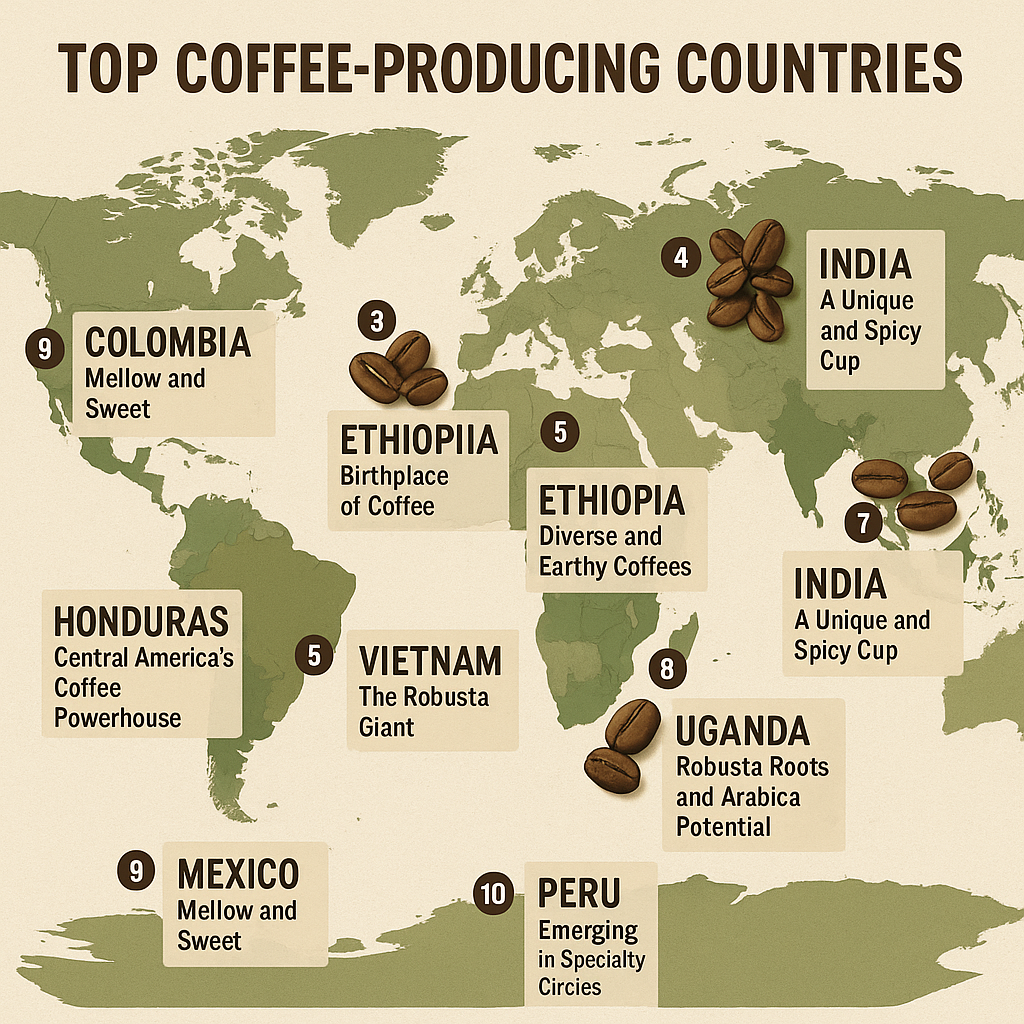
Coffee is one of the most traded commodities on Earth, second only to oil. Every year, millions of tons of coffee beans are harvested, processed, and shipped around the globe — fueling cafés, offices, homes, and rituals in every corner of the world.
But where exactly does all this coffee come from? In this article, we’ll explore the top coffee-producing countries in the world, what makes their coffee unique, and how each region contributes to the flavors you enjoy in your daily cup.
1. Brazil: The Undisputed Leader
- Annual Production: Over 60 million 60-kg bags
- Main Varieties: Arabica and Robusta (locally called Conilon)
- Famous Regions: Minas Gerais, São Paulo, Espírito Santo, Bahia
Brazil has been the world’s largest coffee producer for more than 150 years. Its vast landscapes, diverse climates, and efficient production systems allow it to dominate the market.
What makes Brazilian coffee special:
- Balanced, chocolatey, and nutty flavor profiles
- Suitable for espresso, blends, and filter coffee
- Home to innovative and high-quality specialty producers
2. Vietnam: The Robusta Giant
- Annual Production: Around 30 million bags
- Main Variety: Robusta
- Famous Region: Central Highlands (Gia Lai, Dak Lak, Lam Dong)
Vietnam is the world’s second-largest coffee producer — and the top producer of Robusta beans. Coffee became a major industry in Vietnam after economic reforms in the 1980s.
What makes Vietnamese coffee unique:
- Strong, bold, and bitter Robusta beans
- Essential for instant coffee and espresso blends
- Famous for its traditional brewing method using a phin filter, and sweetened condensed milk
3. Colombia: The Icon of Arabica Quality
- Annual Production: Around 14 million bags
- Main Variety: Arabica
- Famous Regions: Huila, Antioquia, Nariño, Tolima
Colombia’s mountainous terrain, tropical climate, and rich volcanic soil create ideal conditions for Arabica cultivation. Colombian coffee is often praised for its high quality and consistency.
Flavor profile:
- Bright acidity
- Fruity and floral notes
- Smooth, medium body
Colombia is also known for its strong branding and commitment to smallholder farming.
4. Indonesia: Diverse and Earthy Coffees
- Annual Production: Around 10 million bags
- Main Varieties: Arabica and Robusta
- Famous Islands: Sumatra, Java, Sulawesi, Bali
Indonesia is an archipelago with a long coffee history, dating back to Dutch colonialism. Its coffees are often processed using wet hulling, which gives them a distinct flavor.
Taste characteristics:
- Earthy, herbal, and spicy
- Low acidity, full-bodied
- Popular in dark roast blends
Indonesia is also home to some of the rarest coffees in the world, including Kopi Luwak (civet coffee).
5. Ethiopia: The Birthplace of Coffee
- Annual Production: Around 7 million bags
- Main Variety: Arabica
- Famous Regions: Yirgacheffe, Sidamo, Harrar
Ethiopia is considered the cradle of coffee. It’s home to thousands of wild coffee varietals and a rich coffee culture.
Flavor profile:
- Floral, citrusy, tea-like
- Complex and vibrant
- Grown mostly by smallholder farmers in traditional systems
Ethiopian coffees are a favorite among specialty coffee lovers and are often used in high-end single-origin brews.
6. Honduras: Central America’s Coffee Powerhouse
- Annual Production: Around 6 million bags
- Main Variety: Arabica
- Famous Regions: Copán, Marcala, Santa Bárbara
Once overshadowed by its neighbors, Honduras has become one of the largest and most promising coffee producers in Central America. The country has invested heavily in quality control and farmer education.
Taste notes:
- Sweet and nutty
- Balanced acidity
- Great for both espresso and filter coffee
7. India: A Unique and Spicy Cup
- Annual Production: Around 6 million bags
- Main Varieties: Arabica and Robusta
- Famous Regions: Karnataka, Kerala, Tamil Nadu
Coffee has been grown in India since the 1600s, and today it is known for its monsooned Malabar — a process where beans are exposed to monsoon winds, giving them a low-acid, heavy-bodied flavor.
Why Indian coffee stands out:
- Often used in specialty blends
- Grown under shade with spices like cardamom and pepper
- Milder and earthy in taste
8. Uganda: Robusta Roots and Arabica Potential
- Annual Production: Around 5 million bags
- Main Varieties: Robusta (native) and Arabica
- Famous Regions: Mount Elgon, Rwenzori Mountains
Uganda is one of the few countries where Robusta grows naturally. While Robusta dominates, the country is gaining attention for high-quality Arabica grown in its mountainous regions.
Flavor profile of Ugandan Arabica:
- Fruity and wine-like
- Good acidity
- Clean cup profile
9. Mexico: Mellow and Sweet
- Annual Production: Around 3.5 million bags
- Main Variety: Arabica
- Famous Regions: Chiapas, Veracruz, Oaxaca
Mexico is a major supplier of organic coffee, with a strong focus on sustainability and cooperative farming.
Flavor characteristics:
- Mild acidity
- Sweet, nutty notes
- Ideal for blends and mild brews
10. Peru: Emerging in Specialty Circles
- Annual Production: Around 3–4 million bags
- Main Variety: Arabica
- Famous Regions: Cajamarca, Cusco, Amazonas
Peru is gaining attention in the specialty coffee world thanks to its organic production and high-altitude farming. Many producers are part of small cooperatives that emphasize quality and sustainability.
Taste profile:
- Bright, floral, and citrusy
- Clean and elegant
- Great for single-origin coffees
Honorable Mentions
- Guatemala: Known for its rich, chocolatey Arabicas
- Costa Rica: Strong specialty coffee industry and innovative processing
- Kenya: Famous for juicy, berry-like flavors and auction system
- Tanzania: Home to the unique Peaberry coffee
Final Sip: The World in Your Cup
From the bold Robusta of Vietnam to the delicate florals of Ethiopian heirloom beans, the diversity of global coffee production is immense. Each country contributes something special — shaped by its climate, soil, history, and people.
The next time you sip your favorite brew, take a moment to think about the journey those beans have taken — and the cultures, farmers, and regions behind every aromatic cup.