
If you’ve ever compared a bag of 100% Arabica coffee with a generic “traditional” supermarket blend, you may have wondered what really makes them different. Is Arabica worth the hype? Does traditional coffee mean lower quality?
In this article, we’ll explore the real differences between Arabica coffee and traditional blends, how they’re produced, how they taste, and which one is better depending on your preferences and brewing habits.
What Is Arabica Coffee?
Arabica (Coffea arabica) is one of the two most commercially important coffee species, alongside Robusta (Coffea canephora).
Arabica accounts for about 60–70% of global coffee production and is considered superior in flavor, aroma, and overall quality.
Key characteristics:
- Grows best at high altitudes (1,200–2,200m)
- Requires more care, making it more expensive to cultivate
- Susceptible to pests and diseases
- Has a smoother, more complex flavor
Arabica beans are often used in specialty and gourmet coffees, where quality is prioritized over quantity.
What Is “Traditional” Coffee?
“Traditional” coffee usually refers to mass-market blends made with:
- Robusta beans
- Or Arabica + Robusta blends
- Often lower-grade beans roasted dark to hide defects
- Frequently used for instant coffee, commercial espresso, or grocery store brands
Common traits of traditional coffee:
- Strong, bitter taste
- Higher caffeine content
- Lower cost
- Focus on volume over flavor nuance
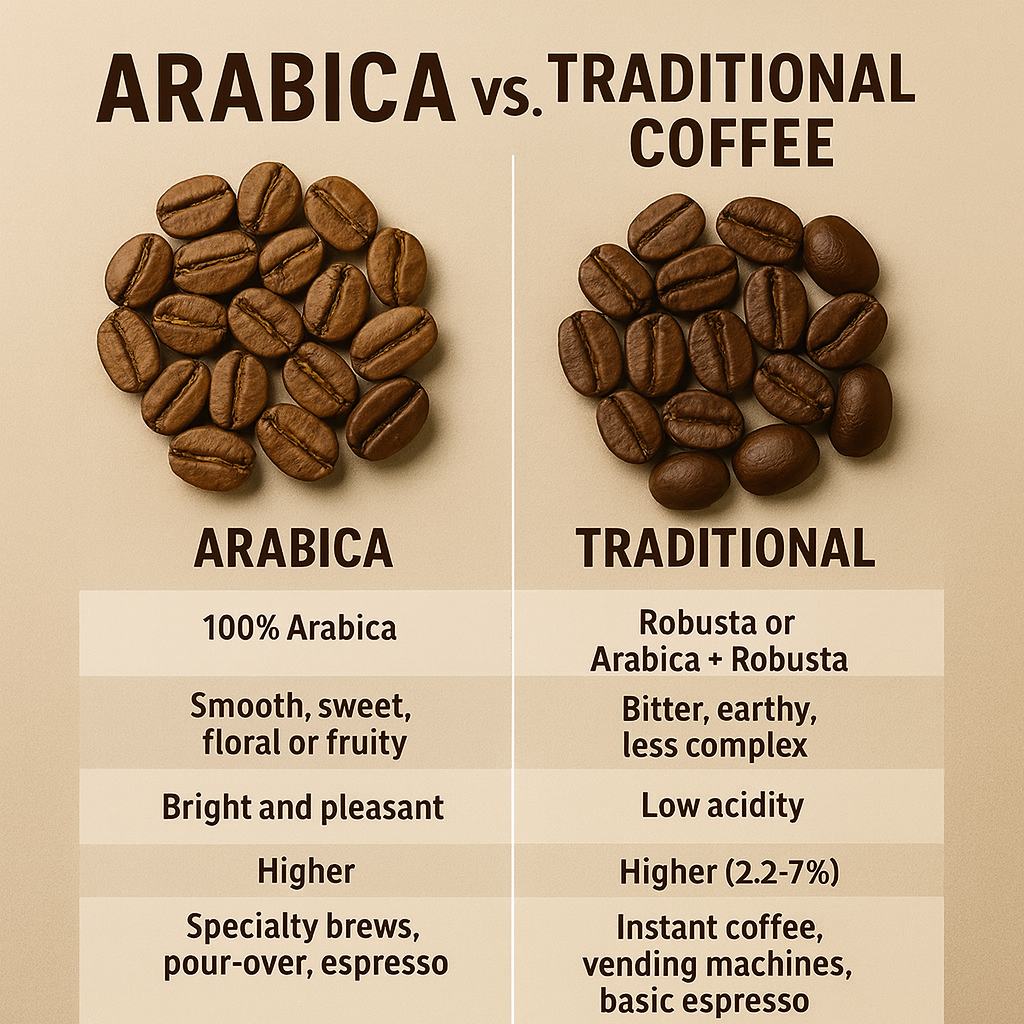
Arabica vs. Traditional Coffee: Side-by-Side Comparison
| Feature | Arabica Coffee | Traditional Coffee (Robusta or Blend) |
|---|---|---|
| Bean Type | 100% Arabica | Robusta or Arabica + Robusta |
| Flavor | Smooth, sweet, floral or fruity | Bitter, earthy, less complex |
| Acidity | Bright and pleasant | Low acidity |
| Caffeine | Lower (1.2%) | Higher (2.2–2.7%) |
| Price | Higher | Lower |
| Usage | Specialty brews, pour-over, espresso | Instant coffee, vending machines, basic espresso |
| Roast Style | Light to medium to preserve origin | Often dark roast to cover flaws |
| Grind Quality | Often freshly ground | Often pre-ground in bulk |
How to Tell Which One You’re Buying
Look for these signs of Arabica:
- Clearly labeled “100% Arabica”
- Tasting notes like: “citrus, chocolate, floral, berry”
- Region or farm identified (e.g., Ethiopia – Yirgacheffe)
- Roasted date is fresh (within 30 days)
- Higher price point
- Often from local roasters or specialty shops
Signs of Traditional/Lower-Grade Coffee:
- No mention of bean type
- Generic “strong” or “bold” on label
- No roast date, only “best before”
- No information on origin
- Very low price per kilo
Which One Should You Choose?
It depends on your needs, taste, and budget.
Choose Arabica if:
- You enjoy flavor complexity
- You prefer less bitterness
- You brew using pour-over, Chemex, French press, AeroPress
- You want to explore single-origin or specialty coffees
Choose traditional blends if:
- You want a strong caffeine hit
- You drink coffee with milk or sugar
- You make espresso at home and prefer a bold crema
- You need a budget-friendly option
Pro Tip: Many Italian-style espresso blends use a mix of Arabica and Robusta to balance flavor and crema. So don’t rule out blends — just check the percentage and roast level.
Health Differences Between Arabica and Robusta
- Caffeine: Robusta has nearly double the caffeine, which may cause more jitters for sensitive drinkers.
- Chlorogenic Acids: Robusta contains more, which may provide antioxidant benefits — but also adds bitterness.
- Sugar and Lipid Content: Arabica contains more sugars and fats, contributing to its smoother flavor.
From a health standpoint, both are safe, but the flavor experience is vastly different.
Why Arabica Dominates the Specialty Market
Specialty coffee — from your favorite café to award-winning single-origin beans — almost always uses Arabica. Why?
- Grown with more care and attention
- Emphasizes origin characteristics (terroir)
- Allows for lighter roasts that highlight flavor notes
- Valued for its aromatic complexity
Robusta is typically used in commercial products, while Arabica leads in quality-focused spaces.
Final Sip: It’s Not Just About Labels — It’s About Experience
Arabica and traditional coffee serve different purposes. Neither is inherently bad — it’s all about what you value in your cup.
If you want an experience filled with flavor discovery, delicate notes, and smooth sips, Arabica is your friend. If you need an affordable, strong brew to fuel your day, a traditional blend might do the trick.
The key is knowing what you’re drinking — and why. Armed with this knowledge, you’ll make better choices that suit your taste, budget, and brewing style.