
You see it on menus and grocery store shelves: decaf coffee. It’s often the go-to choice for late-night coffee lovers or those trying to cut back on caffeine.
But here’s a common question: Is decaf really caffeine-free? And if not, how much caffeine does it actually contain?
In this article, we’ll dive into the truth about decaf coffee — how it’s made, how much caffeine remains, and whether it’s a good choice for you.
What Is Decaf Coffee?
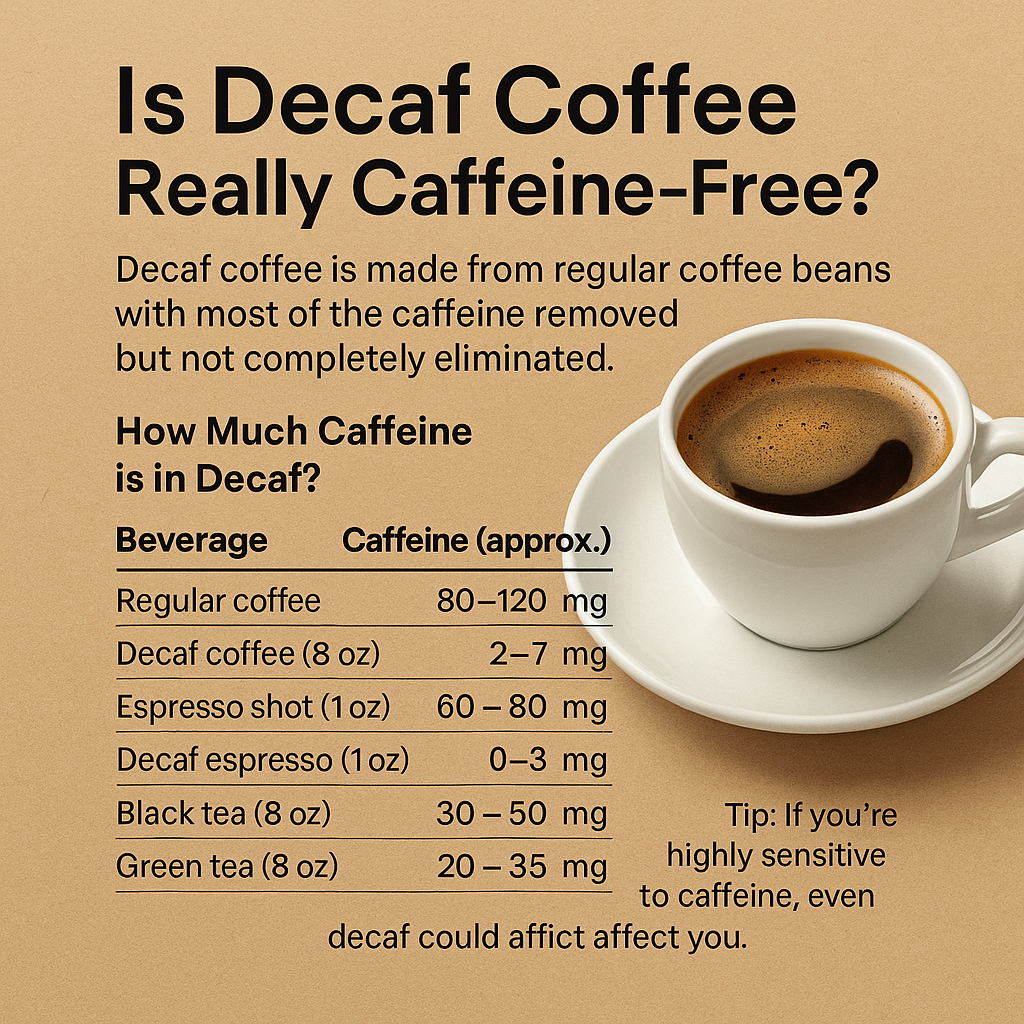
Decaf coffee is made from regular coffee beans that have had most of the caffeine removed. But “decaffeinated” doesn’t mean “caffeine-free.”
According to international standards:
- Decaf must have at least 97% of the caffeine removed
- In the EU, it must be 99.9% caffeine-free by mass
So, while decaf has significantly less caffeine, it still contains a small amount.
How Much Caffeine Is in Decaf?
Here’s a comparison:
| Beverage | Caffeine (approx.) |
|---|---|
| Regular coffee (8 oz) | 80–120 mg |
| Decaf coffee (8 oz) | 2–7 mg |
| Espresso shot (1 oz) | 60–80 mg |
| Decaf espresso (1 oz) | 0–3 mg |
| Black tea (8 oz) | 30–50 mg |
| Green tea (8 oz) | 20–35 mg |
So, while decaf has significantly less caffeine, it’s not zero.
Tip: If you’re highly sensitive to caffeine, even decaf could affect your sleep or anxiety levels.
How Is Coffee Decaffeinated?
There are several methods used to remove caffeine from coffee beans. All are done before roasting, while the beans are still green.
1. Swiss Water Process
- Uses water and osmosis to remove caffeine
- 100% chemical-free
- Often used for organic or specialty decaf
2. Carbon Dioxide (CO₂) Process
- Uses pressurized CO₂ to target and remove caffeine
- Retains flavor well
- Common in large-scale decaf production
3. Solvent-Based (Methylene Chloride or Ethyl Acetate)
- Uses solvents to extract caffeine
- Beans are steamed before and after to remove residues
- Safe and approved by FDA, but not popular with purists
4. Sugarcane Process (EA Natural)
- Uses natural ethyl acetate from sugarcane
- Popular in Colombia
- Mild, sweet decaf flavor
Each method has pros and cons, especially regarding flavor retention and chemical use.
Does Decaf Taste Different?
Yes — and no.
High-quality decaf made with careful processing can taste very similar to regular coffee. But some decaf coffees:
- Taste flatter or less vibrant
- Lack the complexity of caffeinated beans
- May have slightly different roast profiles to compensate
Roasters have improved their techniques, and specialty decaf has come a long way — especially with the Swiss Water or Sugarcane methods.
Why People Choose Decaf
Decaf is a great option for people who:
- Are sensitive to caffeine
- Want to reduce anxiety or heart palpitations
- Want to enjoy coffee late at night
- Are pregnant or breastfeeding (consult your doctor)
- Have health conditions aggravated by caffeine
It lets you enjoy the ritual and taste of coffee without the stimulant effects.
Is Decaf Healthier Than Regular Coffee?
Not necessarily. Both decaf and regular coffee offer health benefits, such as:
- Antioxidants
- Improved liver health
- Lower risk of certain diseases
Decaf has slightly fewer antioxidants (some are lost during processing), but it still contains many health-promoting compounds.
Things to Consider When Buying Decaf
- Look for Swiss Water or EA processed decaf if you want chemical-free
- Buy freshly roasted decaf from a specialty roaster
- Check the roast date — freshness matters, even with decaf
- Try single-origin decaf for more interesting flavor profiles
Final Sip: Decaf Isn’t Fake Coffee
Decaf coffee often gets a bad reputation — but it’s far from fake. It’s real coffee, with real flavor, minus most of the caffeine.
Whether you’re cutting back, drinking late at night, or simply curious, decaf can be a satisfying part of your coffee journey — especially when sourced and brewed with care.
So the next time you want a cup without the buzz, know that decaf has your back — and your taste buds.